

What if the difference between an expensive mistake and a safe DeFi interaction is a simulation that shows you exactly what will change in your wallet before you hit “confirm”? That claim—simple, almost prosaic—helps reframe how sophisticated DeFi users should evaluate browser wallets. Rabby’s Chrome/Chromium extension is not merely another interface to your keys; it layers transaction simulation, risk scanning, and revocation tools into the signing flow. For power users who move assets across chains and contracts, those features are mechanism-level defenses, not cosmetics.
Below I explain how Rabby’s extension works in practice, what problems it actually reduces (and which it does not), and a practical decision framework for when to prefer Rabby over other EVM wallets. I’ll identify common misconceptions, show the trade-offs around custody and convenience, and end with concrete red flags and near-term signals to monitor in the US DeFi environment.
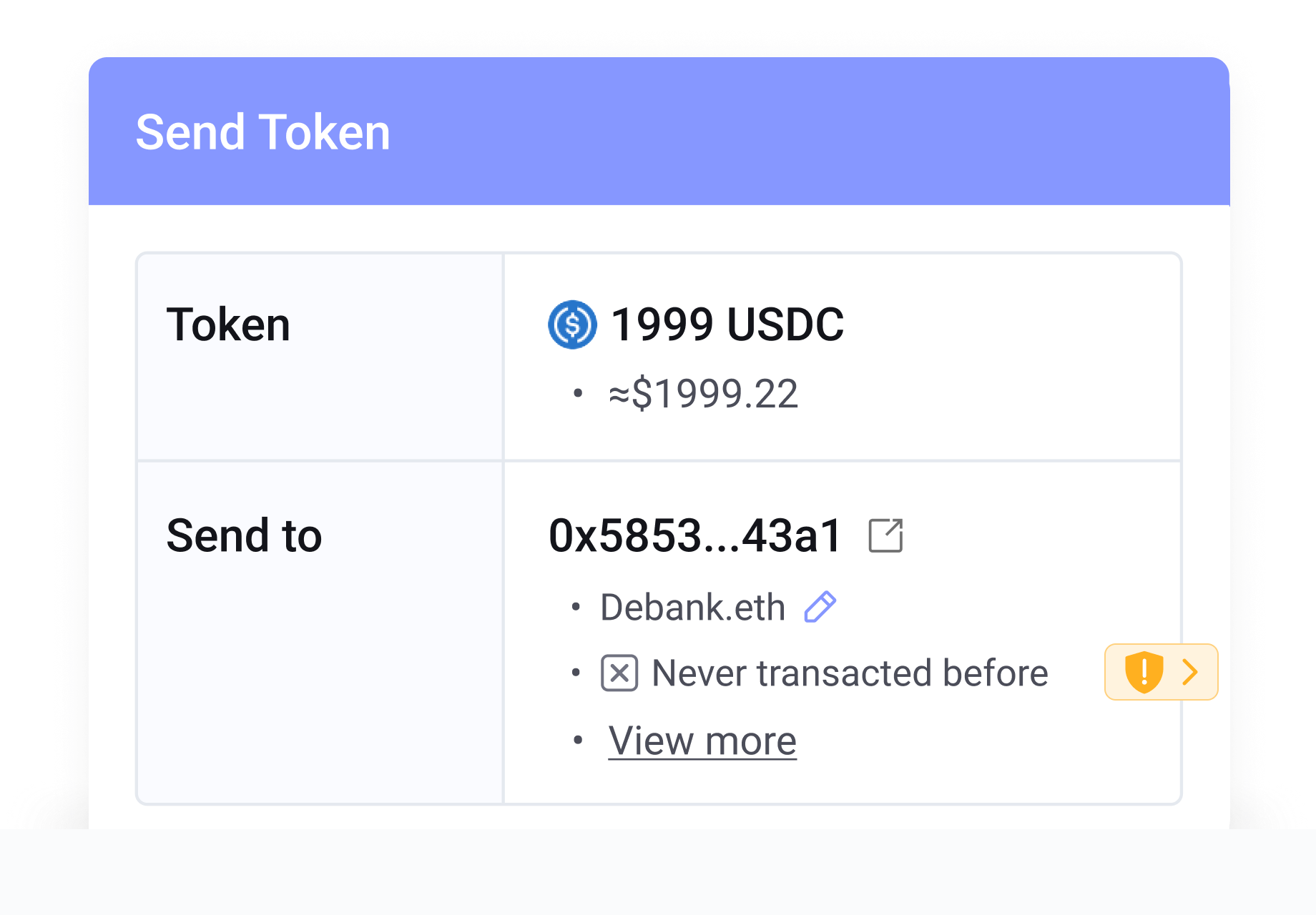
How Rabby’s Chrome extension changes the signing calculus
At its core Rabby is a non-custodial, multi-chain wallet developed by DeBank that plugs into Chromium browsers. The technical distinction that matters most for security-minded users is transaction simulation: before you sign, Rabby executes a dry-run of the transaction against a node to estimate token balance deltas, gas costs, and any state changes. That single mechanism addresses a common attack vector—“blind signing”—where a user signs an opaque payload and later discovers unwanted approval or asset movements.
Transaction simulation is not magic. It relies on reading the intended transaction calldata, running it against the current chain state, and showing estimated results. That enables two practical outcomes: first, you see an explicit estimate of token outflows and inflows (so a swap that will wipe one token becomes visible); second, the extension can flag mismatches, such as unusually large approval amounts, transfers to new recipient addresses, or calls to contracts with known compromise histories. The latter comes from Rabby’s built-in security engine and risk database.
What Rabby actually prevents—and what it won’t
Misconception: simulation equals invulnerability. Correction: simulation reduces specific classes of user-facing risk but does not eliminate systemic risks or bad on-chain logic. Rabby prevents many instances of accidental overspending, malicious approval creep, and signing of obviously harmful transactions. But it cannot protect against a benign-looking transaction that encodes complex, valid logic producing a harmful off-chain effect, or from vulnerabilities in the dApp contract itself that only manifest under certain economic conditions.
Two boundary conditions to keep in mind. First, the simulation is only as accurate as the node state and the transaction inputs at the moment of simulation—race conditions, frontrunning, or state changes between simulation and mined inclusion can change outcomes. Second, simulation doesn’t stop logic-level bugs in third-party contracts (e.g., flawed accounting in a yield strategy); it only shows what that contract will do to your balances, which is useful but not a full substitute for code-level audit or protocol risk assessment.
Security features to weigh: hardware support, revocation, and multi-sig
Rabby’s extension integrates with common hardware wallets—Ledger, Trezor, Keystone and others—so private keys can remain offline while the extension handles simulations and UI. For institutional or higher-value accounts, Rabby’s compatibility with Gnosis Safe and custody platforms like Fireblocks matters: you get simulation and risk scanning as an additional layer in multi-sig workflows. That changes the threat model; an attacker would need to compromise both the multisig policy and the off-chain risk signals to execute a quiet exploit.
Another practical detail: Rabby includes an on-chain approval revocation tool. In the US DeFi context where composability increases exposure, being able to view and cancel token allowances reduces your attack surface. This is a subtle but high-leverage control—revocations limit the window in which a compromised dApp or an attacker who gains a private key can sweep tokens.
Where Rabby outcompetes and where MetaMask still has advantages
Rabby differentiates itself from major competitors (MetaMask, Trust Wallet, Coinbase Wallet) via automatic network switching, transaction simulation, and pre-transaction risk scanning. That combination reduces friction and cognitive load for power users who jump between Ethereum, Layer-2s, and many EVM chains (Rabby supports over 90). If you frequently interact with unfamiliar contracts across chains, this matters.
However, there are trade-offs. Rabby does not provide an in-wallet fiat on-ramp or native staking interfaces—features that mainstream wallets sometimes bundle for consumer convenience. If your workflow depends on buying fiat-to-crypto inside the wallet, you’ll need external services. Also note that no extension can fully remove phishing risks from malicious web pages; good operational hygiene (whitelisting domains, checking contract addresses, and using hardware confirmations) remains essential.
Operational heuristics: a short checklist for DeFi power users
Here are practical rules of thumb you can use immediately:
For more information, visit rabby wallet.
- Always enable hardware wallet signing for large transfers and approvals; use Rabby’s integration rather than relying solely on extension keypairs.
- Use Rabby’s simulation to verify token delta before confirming swaps; if the results show unexpected recipient addresses or extra token drains, abort and investigate.
- Regularly run the built-in approval revocation across networks—especially after using bridges or DEX aggregators.
- For institutional flows, combine Rabby’s scans with a multi-sig guard (Gnosis Safe) to reduce single-point failures.
- Don’t equate automatic network switching with safety—confirm the domain and the contract address before signing even if Rabby switches you to the expected chain.
Limitations, incidents, and the honest risk picture
Rabby’s architecture is open-source (MIT), which helps independent reviews; but openness is not a panacea. In 2022 a Rabby-associated contract (Rabby Swap) was exploited for about $190,000. The team froze the contract and compensated users, then increased audits—useful steps, but they highlight that runtime contract risk exists even for teams with a strong security posture. Open-source code can be audited, yet subtle vulnerabilities in smart contracts or integrations are an ongoing risk in DeFi.
Another limitation: Rabby lacks native staking and direct fiat purchasing. For US-based users who want an all-in-one consumer experience, that means combining tools: Rabby for signing and simulation, a separate exchange or on-ramp for fiat conversion, and possibly a staking interface or protocol UI for yield operations. That modularity is deliberate and often preferable for power users who want clear separations of responsibility, but it does add operational steps.
Decision framework: when to choose Rabby (and when not to)
If you are a high-frequency DeFi trader, liquidity provider, or manage multi-chain positions, Rabby’s transaction simulation and approval controls materially reduce everyday operational risk. Choose Rabby when you need: cross-chain convenience with automatic network switching, explicit pre-signing risk signals, hardware wallet support, and the ability to revoke approvals quickly.
Decline Rabby (or pair it with another tool) when your primary need is fiat convenience, or when you require built-in staking dashboards and simpler consumer flows. Also, if you rely on non-Chromium browsers, the extension won’t be available; Rabby supports Chrome, Brave, and Edge for its extension, plus mobile and desktop clients for other contexts.
What to watch next (conditional signals, not predictions)
Monitor these developments as near-term signals of improvement or new risk: (1) expanded automated audits tied to release pipelines, which would reduce the chance of contract regressions; (2) deeper integrations with regulated custody providers in the US, which could make Rabby more attractive to institutional actors; and (3) enhancements to simulation fidelity that reduce race-condition gaps between simulation and mined outcome. If any of these appear as concrete product changes, Rabby’s risk-reduction value will increase—conditional on implementation quality.
Conversely, attention to how Rabby handles third-party dApp integrations and bridge flows matters. Bridges remain a systemic risk; a wallet can only surface certain categories of risk but cannot immunize users from protocol-level exploits.
FAQ
Is Rabby safe enough to use as my main DeFi wallet?
“Safe enough” depends on your threat model. Rabby reduces signing risks through simulation, revocation tools, and risk scanning—but it does not replace good operational discipline: hardware keys, verified contract addresses, multi-sig where appropriate, and external audits for any protocols you entrust with funds. For many active DeFi users in the US, Rabby can serve as a primary wallet when paired with hardware signing and periodic allowance hygiene.
How reliable is transaction simulation—could it lie or be wrong?
Simulation reports are estimates based on current chain state. They are reliable for detecting obvious issues (unexpected recipient, huge approvals, estimated token deltas), but they can be affected by state changes between simulation and the block’s inclusion, frontrunning, or non-deterministic contract behavior. Treat simulations as a powerful heuristic, not an absolute guarantee.
Does Rabby support hardware wallets and institutional custody?
Yes. Rabby integrates with Ledger, Trezor, Keystone, CoolWallet, GridPlus, BitBox02, and supports institutional solutions like Gnosis Safe, Fireblocks, Amber, and Cobo. That makes it practical for both individual power users and institutional workflows that require multi-sig and enterprise-grade custody.
Where can I learn more and try the extension?
For installation guidance and feature details, the project maintains official resources including an extension and downloads; one useful landing page is the rabby wallet documentation and download hub.

